
GetSkill Online: An E-Commerce Web Development Case Study for a UK Online Certification Course Platform
How Teknoppy built a scalable, high-trust ecommerce learning platform for GETSKILLONLINE LTD, uniting nine disparate professional categories, course bundles, and multi-tier enrollment paths.
AT A GLANCE
About GetSkill Online
GetSkill Online (GETSKILLONLINE LTD, Blackburn, UK) sells certificate and diploma-style online courses across construction, health & social care, business, HR, beauty, and more, to learners across the UK.
An ecommerce platform selling training across genuinely unrelated industries faces a catalog and trust problem a single-category store doesn't. A construction worker and a beauty therapist have nothing in common except that both are considering the same unfamiliar step — enrolling in online-only certification — so the platform has to build that same confidence across wildly different audiences at once, without any one category's content diluting another's.
The scale of the catalog compounds this. Nine categories, individual courses, and bundle options all need their own clear place in the structure, and a learner arriving through a construction-specific search should never feel like they've landed on a generic, unrelated marketplace rather than a platform genuinely built for their field.
The Challenge
Selling certification across this many unrelated fields exposes problems a narrower ecommerce store never has to solve.
No structure for a cross-industry catalog
Courses across construction, healthcare, business, HR, and beauty sat together without clear categorization, making it hard for learners to find courses relevant to their field.
No bundle purchasing option
Only single-course enrollment was available, with no lower-commitment or better-value bundle path for learners exploring a new field.
No visible trust signals
Without named student testimonials or a stated learner count, there was little to counter the natural hesitation of enrolling in a skill you've never trained in.
A single, high-friction enrollment path
With no WhatsApp enquiry option or lead form alongside direct enrollment, learners had one way in regardless of how ready they were to commit.
No visible registration or compliance signals
Without a displayed UK company registration and address or GDPR cookie consent controls, the platform gave learners little to verify legitimacy or compliance — a real concern in a category where online course scams are common enough that cautious buyers actively check for this.
Project Objective
Teknoppy's goal was to build an ecommerce platform that could:
Present a wide, cross-industry course catalog clearly, without one category diluting another
Support course bundles alongside individual courses in the same purchasing flow
Give learners the confidence to enroll in a skill they'd never trained in before
Meet learners at different stages of readiness with more than one way to engage
Make the business's legitimacy and compliance verifiable, not just claimed
Our Approach
How Teknoppy built a low-friction, multi-audience UK e-learning commerce architecture:
A wide category structure built for genuinely different audiences
Construction, Health & Social Care, Administration, AI Integration, Business, HR, Beauty, Animal Care, and Fast Track categories sit side by side, letting a single platform serve very different learner audiences without feeling scattered. Each category was treated as its own topical space rather than folded into a single generic "courses" list.
Bundle and single-course purchasing, side by side
Course bundles — such as a Construction and Building Bundle and a Health and Social Care Bundle — are sold alongside individual certificates, giving learners a lower-commitment entry point and a value option within the same catalog rather than forcing a single-course-only decision.
Testimonial-driven trust building
Named, role-specific student testimonials — sales executives, HR assistants, nursing students, housewives changing careers — are surfaced prominently, addressing the core hesitation of enrolling in a skill you've never trained in with real people who've already made that decision successfully.
Multiple low-friction enrollment paths
WhatsApp enquiry links, a "Get Started" lead form, and direct course enrollment all sit on the same pages, meeting learners at whichever stage of decision-making they're actually at, rather than assuming every visitor is ready to buy immediately.
Registered business transparency and GDPR-ready cookie consent
The company's UK registration number and Blackburn address are displayed in the footer, and a cookie preference banner with granular "Necessary Only" versus "Allow All" controls keeps the platform compliant for UK and EU visitors — concrete, checkable facts rather than a vague trust claim.
Social proof and a simplified enrollment path
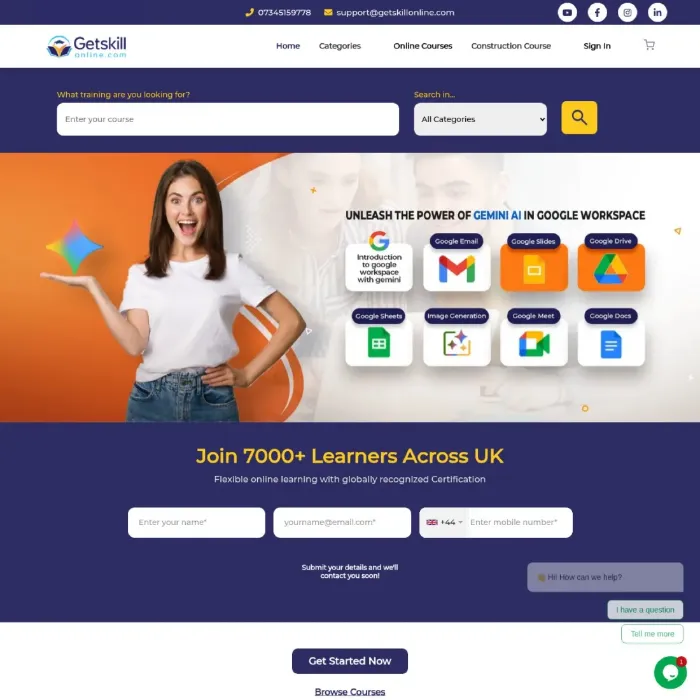
A "Join 7000+ Learners Across UK" banner is repeated at key decision points on the homepage, reinforcing scale for a UK-wide audience considering online-only training, while a simplified three-step process — Choose & Enroll, Learn & Practice, Complete & Get Certified — breaks the buying decision into a clear, low-anxiety sequence for learners unfamiliar with how online certification actually works.
Mobile-first checkout for a decision often made between other tasks
Many learners exploring a course change are doing it in spare moments — on a break, in the evening, between other responsibilities — rather than sitting down specifically to shop. Category browsing, bundle comparison, and checkout were all built mobile-first, so the decision to enroll doesn't stall out because a page or a payment form doesn't work well on a phone.
What We Delivered
Wide category structure built for cross-industry courses
Construction, Health & Social Care, Administration, AI Integration, Business, HR, Beauty, Animal Care, and Fast Track categories sit side by side, letting a single platform serve very different learner audiences without feeling scattered.
Bundle and single-course purchasing side by side
Course bundles are sold alongside individual certificates, giving learners a lower-commitment entry point and a value option in the same catalog.
Testimonial-driven trust building
Named, role-specific student testimonials are surfaced prominently, addressing the core hesitation of enrolling in a skill you've never trained in.
Multiple low-friction enrollment paths
WhatsApp enquiry links, a lead form, and direct course enrollment all sit on the same pages, meeting learners at whichever stage of decision-making they're at.
Registered business transparency and GDPR-ready cookie consent
UK registration and address are displayed, with granular cookie controls keeping the platform compliant for UK and EU visitors.
Social proof at scale and a simplified enrollment path
A "Join 7000+ Learners Across UK" banner and a clear 3-step process reduce hesitation at the exact moments a learner is deciding whether to commit.
Why This Approach Matters for Online Education E-Commerce
Buying a certification course sits in an unusual middle ground — it's a purchase, but it's also a decision that can affect someone's career and income, which pulls it closer to the scrutiny search engines apply to YMYL content than a typical ecommerce category gets. Concrete, checkable facts — a real UK company registration, a specific address, named testimonials with real roles — do more to earn trust here than generic "trusted by thousands" marketing language, especially in a category where online course scams have made cautious buyers actively look for exactly these signals before paying.
Spanning genuinely unrelated industries also creates an unusual semantic SEO challenge: the site has to build topical authority in several separate clusters at once — construction certification, healthcare certification, beauty certification — rather than depth in a single niche. Treating each category as its own clearly bounded topical space, rather than blending them into one generic "online courses" identity, is what lets each category build its own relevance in search rather than diluting the others.
This structure also matters for how learners increasingly research training options through AI tools before committing — asking something like "best online HR certification UK" or "is an online construction safety course worth it." A platform with genuinely separated, detailed category content gives those tools accurate, specific information to draw from for each field, rather than one broad course-selling site that can't answer a category-specific question with any real precision.
By structuring nine unrelated course categories clearly, building trust through named testimonials and verifiable registration details, and meeting learners at whatever stage of readiness they're at, the GetSkill Online platform is built to convert genuine hesitation into enrollment across a genuinely wide range of learners. See more examples in Teknoppy's full case study library or our ecommerce development service.
Frequently Asked Questions
To build an ecommerce platform that could sell certificate courses across very different industries — from construction to healthcare to beauty — in one clear, trustworthy catalog.
Written by Sanal Edison, Digital Strategist at Teknoppy.
Need an ecommerce platform that makes a wide, cross-category catalog easy to trust and easy to buy from?
TEKNOPPY.COM • KOCHI, KERALA • DUBAI, UAE