
Kerala Dayz: A Search Engine Optimization (SEO) Case Study for a Kochi Taxi & Tour Operator
How Teknoppy consolidated fragmented local Google listings, resolved NAP inconsistencies, and built a zero-cannibalization 8-pillar hub-and-spoke architecture for a competitive Kochi transport business.
AT A GLANCE
About Kerala Dayz
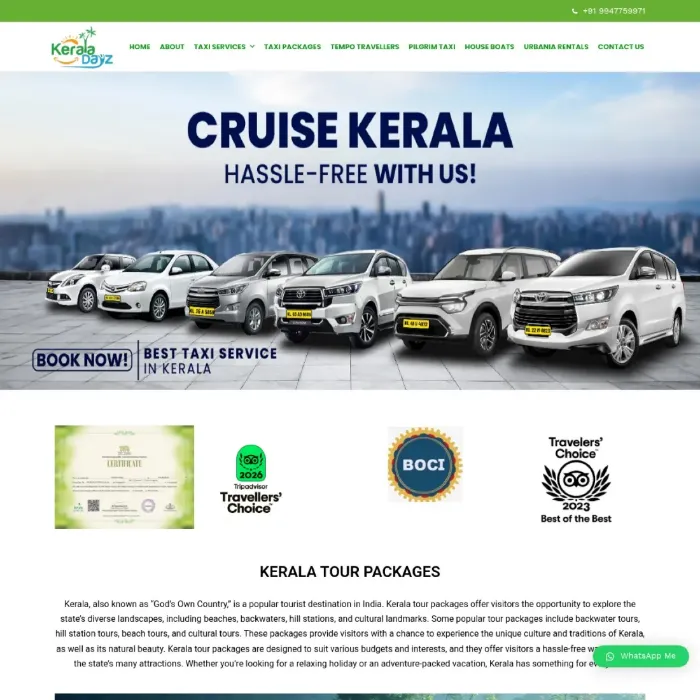
Kerala Dayz is a Nedumbassery, Kochi-based taxi and tour operator offering airport transfers, Kerala tour packages, pilgrim taxi services to Sabarimala, tempo traveller and fleet rentals, and outstation routes across Kerala, Karnataka, and Tamil Nadu.
The taxi and tour operator space in Kochi is genuinely crowded — multiple established local brands compete for the same searches every day. Before this engagement, Kerala Dayz's SEO problem wasn't a single obvious fix; it was two compounding issues at once: a local listing presence that was actively working against itself, and a site with no structural plan for how dozens of overlapping service and route pages should relate to one another.
The Challenge
Independent audits before this project surfaced problems that don't show up from a single glance at the website itself.
Fragmented local presence
Audits found NAP (Name, Address, Phone) inconsistencies across 3–4 separate Google listings, including a duplicate, similarly-named "Kerala Holiday Taxi" listing, splitting local ranking signals across multiple profiles instead of consolidating them into one.
Low Google Business Profile completeness
Independent audits scored the GBP profile at 54–58 out of 100 across separate reviews, well behind what's needed to compete with established local competitors for the local map pack.
No cannibalization-proof site structure
With overlapping services — taxi services, tour packages, pilgrim taxi, tempo traveller rentals — spread across pages with no consistent architecture, the site risked its own pages competing against each other in search rather than each owning a distinct topic.
No competitor benchmarking
Pages were built without checking what already ranked well for the same searches, missing the chance to identify gaps against direct competitors like Kochi Taxi 24X7, Pepper Kerala Holidays, and Mallu Cabs.
No consistent content standard
Word counts and keyword density varied page to page with no verifiable method behind them, creating a real risk of either thin, under-optimized pages or content so keyword-dense it reads unnaturally and can work against rankings rather than for them.
Project Objective
Teknoppy's brief was to build an SEO foundation that could:
Consolidate fragmented local listings and address the audited GBP completeness gap through a phased action plan
Build a zero-cannibalization, hub-and-spoke architecture across every service, location, and route
Benchmark every page against named, real competitors rather than generic template content
Apply a consistent, verifiable word count and keyword density standard across the entire site
Support real search intent for routes, locations, fleet options, and pilgrim travel with dedicated, distinct pages
Our Approach
How Teknoppy built a cannibalization-proof architecture grounded in empirical local auditing:
Auditing before building anything
Discovery started with three separate rounds of Google Business Profile and local SEO auditing, rather than jumping straight into content. That established an accurate baseline — the exact listing fragmentation, the specific GBP completeness score, and where competitors were already positioned — before a single page was planned. Building an SEO strategy on an unverified assumption about the current state is one of the more common reasons local SEO work underperforms.
A hub-and-spoke architecture governed by one cannibalization matrix
Every pillar — routes, locations, fleet, pilgrim travel, and trust/E-E-A-T content — and every child page beneath it was mapped against a single consolidated cannibalization matrix, so no two pages target the same primary search intent. Route pages own specific origin-destination searches, location hub pages own city-level intent, and fleet pages own vehicle-specific intent, with cross-links connecting them rather than overlapping content trying to rank for all of it at once.
The architecture spans eight distinct pillars: core retargeted service pages, location hubs (Kochi, Trivandrum, Munnar, and others), route pages for specific airport-to-destination journeys, fleet and vehicle-type pages, pilgrim and purpose-based travel pages, a trust and E-E-A-T hub (drivers, testimonials, fare calculator, FAQ), and a knowledge-hub blog answering common pre-booking questions. Each pillar has a clearly defined job, so a new page always has an obvious home instead of blurring into whichever section happens to be easiest to add it to.
Competitor-benchmarked page structure
Pillar and child pages were built against a direct gap analysis of named competitors — including Kochi Taxi 24X7, J&J Taxi Service, Pepper Kerala Holidays, BCabs, Mallu Cabs, and Cochin Runway Cabs — rather than generic template content. Where competitor pages were found to be thin or missing structural elements entirely, that gap became the specification for what Kerala Dayz's own page needed to include.
A script-verified content standard, not an estimated one
Word count and keyword density targets were set per page type, then checked with a script against the actual drafted content rather than estimated by eye. That check caught real problems early — keyword density running several times over target on early drafts, well past the point where content reads naturally to a visitor or safely to a search engine — and meant every published page could be verified against its target band rather than assumed to be compliant.
Real, source-verified facts instead of generic filler
Route pages use actual verified distances and landmarks along each highway corridor, fare-calculation content cites real government-regulated rate structures, and trust-page reviews are drawn from Kerala Dayz's own real customer feedback rather than generic placeholder testimonials. For a travel and transport business, specific, checkable details like a real landmark on the route or an accurate government fare band do more to earn a first-time visitor's trust than confident-sounding but generic copy.
What We Delivered
Zero-cannibalization hub-and-spoke architecture
A consolidated cannibalization matrix maps every pillar and child page — routes, locations, fleet, pilgrim, purpose, trust/E-E-A-T — so no two pages compete for the same search intent.
A GBP and NAP cleanup roadmap
A phased action plan addresses listing consolidation, GBP category and completeness fixes, and citation cleanup against the fragmented listings identified in audit.
Competitor-benchmarked page structure
Pillar and child pages were built against a direct gap analysis of named local and regional competitors, rather than generic template content.
A verifiable content standard
Word count and keyword density bands are set per page type and script-checked against the actual content, not estimated.
Real, checkable content throughout
Verified route distances and landmarks, government-regulated fare information, and genuine customer reviews replace generic filler across the site.
Ranking Keywords
Verified Google search rankings for airport taxi, tour transfers, and vehicle rental services across Kerala.
Target keywords — Kerala Airport Taxi & Tour Fleet
| RANKING KEYWORDS | PAGE | POSITION |
|---|---|---|
| Kerala Airport Taxi | 1 | 6 |
| best taxi service in Kerala | 1 | 7 |
| Trustable tour and taxi brand in kochi Bes | 1 | 5 |
| Best Airport Taxi Service in Kerala | 1 | 6 |
| tempo traveller rental Kochi | 1 | 7 |
High-volume tourism and transit search terms driving direct traveler bookings and airport transfers.
Why This Approach Matters for Local Travel SEO
Local search and generative AI answer tools both lean heavily on consistency and verifiability for exactly this kind of business. A consistent Name, Address, and Phone number across every listing is one of the clearest entity-resolution signals Google uses to confirm that "Kerala Dayz" in one place is the same business as "Kerala Dayz" everywhere else — fragmentation across multiple listings actively works against that, no matter how good the website itself is.
Cannibalization avoidance is a topical authority issue as much as a technical one. When a route page, a location hub, and a fleet page each own a distinct, non-overlapping search intent, the site builds depth across dozens of pages instead of several pages faintly competing for the same handful of terms. That structure is also what makes a site legible to AI research tools trying to answer a specific question — "how much is a taxi from Cochin airport to Munnar" has one clear page to draw from, not three competing, half-relevant ones.
Genuine, source-verified content also compounds over time in a way generic filler doesn't. A route page with a real, checkable landmark or an accurate fare reference stays useful and accurate months later; generic "best taxi service in Kerala" copy doesn't age any differently whether it's accurate or not, which is exactly why it does little to build lasting topical authority.
By fixing local listing fragmentation, building a cannibalization-proof architecture, and grounding every page in real, verifiable detail rather than generic filler, the Kerala Dayz SEO foundation is built to compete against established local operators on the terms that actually decide local search rankings. See more examples in Teknoppy's full case study library or our SEO services page.
Frequently Asked Questions
A fragmented local listing presence — NAP inconsistencies across multiple Google listings — combined with a site structure where overlapping service pages risked competing against each other in search.
Written by Sanal Edison, Digital Strategist at Teknoppy.
Need an SEO strategy that fixes a fragmented local presence and stops your own pages from competing with each other?
TEKNOPPY.COM • KOCHI, KERALA • DUBAI, UAE