
Leema Engineering: A Website Design and Development Case Study for a GCC Industrial Supplier
How Teknoppy restructured leemaeng.com across 66 pages, eight distinct topical pillars, and 15 GCC location pages to transform a 50-year industrial supplier's website into a findable procurement due diligence platform.
AT A GLANCE
About Leema Engineering Works
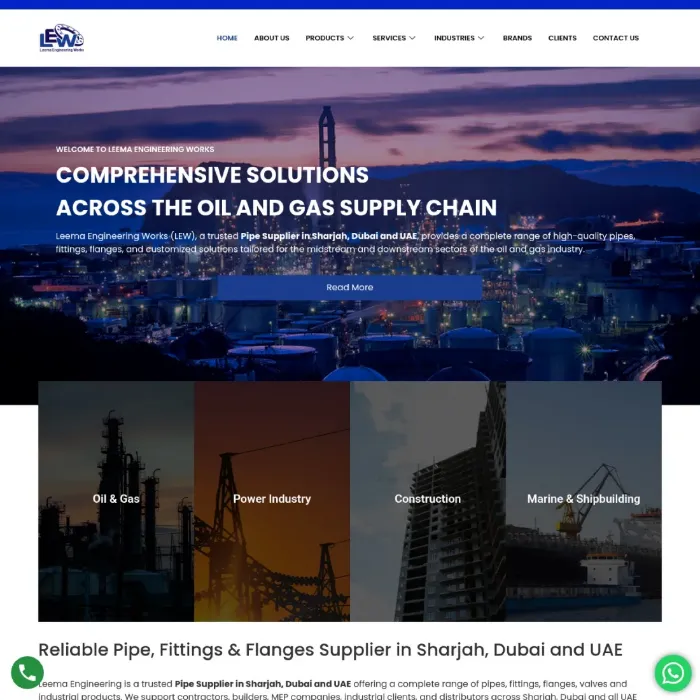
Leema Engineering Works (LEW) is an ISO 9001:2015 certified pipes, fittings, and flanges supplier based in Sharjah, UAE, with more than 50 years of manufacturing and export experience serving the Oil & Gas, Power, Steel, Marine, Water Treatment, Food, and Mining sectors across Sharjah, Dubai, Abu Dhabi, and the wider GCC.
LEW also positions itself as a stockist alternative to Chinese-origin material for Saudi buyers — a distinction procurement teams increasingly look for, but one that only helps if a buyer can actually find and verify it on the website. That gap between what LEW offers and what its old site could actually communicate was the starting point for this project.
A supplier with this kind of scale — multiple product lines, seven industry verticals, and customers spread across several GCC countries — needs a site structure that can hold all of that without collapsing into repetition or vague generalities. Getting that structure right was less about adding new content and more about giving existing facts about the business room to be stated clearly, once each, in the right place.
The Challenge
A 50-year industrial supplier's website needs to work the way a buyer's due diligence process actually works — and LEW's previous structure didn't.
Repetitive, keyword-stuffed content
Phrases like "Sharjah, Dubai and UAE" were repeated throughout nearly every section of the site instead of being supported by structured, location-specific pages, diluting rather than strengthening local relevance.
Products, services, and industries loosely bundled
Pipes, fittings, flanges, valves, and accessories sat under a handful of broad sections rather than a clear, expandable pillar structure, making it hard for a buyer searching for one specific product to land on the page that actually answered their question.
Limited GCC coverage
Only isolated pages existed for Bahrain and Qatar, with no consistent structure extending coverage to the wider GCC market LEW actually serves, leaving real regional demand unaddressed.
Key differentiators buried instead of structured as findable content
ISO 9001:2015 certification, 50 years of manufacturing history, and origin-alternative sourcing for Saudi buyers existed as claims somewhere on the site, but weren't built out as dedicated content a procurement buyer — or a search engine — could easily locate and verify.
No framework to keep expanding pages distinct
With products, services, and 15-plus locations all needing coverage, pages could easily end up targeting the same search terms without a deliberate structure keeping each one distinct from the next.
Project Objective
Teknoppy's brief was to restructure the site so it could:
Replace repetitive location phrasing with real, structured location-specific pages
Organize products, services, and industries under a clear, expandable pillar structure
Extend consistent coverage across the wider GCC, not just isolated Bahrain and Qatar pages
Give ISO 9001:2015 certification, 50-year experience, and sourcing differentiators their own findable, verifiable content
Keep every pillar and location page distinct, so none compete against another for the same search terms
Our Approach
How Teknoppy engineered an eight-pillar structure and cannibalization-aware framework across 66 pages:
An eight-pillar structure replacing scattered sections
Rather than patching the existing page layout, LEW's products, services, and industries were mapped into eight distinct topical pillars across a full 66-page restructure. Each pillar covers one clear area — a product category or industry vertical — in enough depth that a buyer researching that specific need finds a complete answer, rather than a fragment of a broader page trying to cover everything at once.
Real location pages instead of repeated location phrases
Repeating "Sharjah, Dubai and UAE" across dozens of sections doesn't help a page rank for any of those places individually — it just dilutes relevance everywhere at once. Each location LEW actually serves now has its own page, built around that location's specific search intent rather than borrowing generic company-wide copy.
GCC-wide coverage built deliberately, not organically
Fifteen location pages, including Bahrain, now give the site consistent structure across the wider GCC instead of leaving regional coverage to whichever pages happened to get built over time. For a supplier whose actual customer base spans multiple GCC countries, the site's structure now matches the business's real reach rather than trailing behind it.
Certifications and differentiators built as their own findable content
ISO 9001:2015 certification, 50 years of manufacturing and export experience, and LEW's position as a stockist alternative to Chinese-origin material for Saudi buyers were each given dedicated space rather than sitting as a passing mention. For an industrial buyer doing supplier due diligence, these are exactly the facts they're trying to verify before requesting a quote — and content that states them clearly, rather than in a single throwaway line, does real work at that stage of the decision.
A cannibalization-aware framework across pillars and locations
With eight pillars and fifteen locations expanding at once, the structure was planned so overlapping products and regions don't end up competing for the same search terms. Each page was scoped around a distinct primary intent from the start, rather than adjusted after the fact once overlap became a problem.
Content structured for how procurement research actually happens now
A growing share of B2B procurement research starts with a broad question typed into a search engine or an AI research tool — "flange suppliers in Bahrain," "ISO certified pipe fittings UAE" — before a buyer ever visits a specific site. Pages built around one clear product-and-location combination, with the certification and experience details stated plainly rather than buried in a paragraph, are what let both a search engine and an AI summarization tool represent LEW accurately when a buyer asks that kind of question, instead of returning a vague, unattributed answer.
What We Delivered
An eight-pillar content structure.
A full 66-page restructure organizes LEW's products, services, and industries into eight distinct topical pillars, replacing scattered, repetitive sections with a clear, expandable framework.
15 location pages across the GCC.
Dedicated location pages, including Bahrain, extend structured coverage across the wider GCC market instead of leaving it to a couple of isolated pages.
Certifications and differentiators as dedicated content.
ISO 9001:2015 certification, 50 years of experience, and origin-alternative sourcing for Saudi buyers are each built out as their own findable, verifiable content.
Cannibalization-aware structure.
Pillars and location pages are built to stay distinct from one another, so overlapping products and regions don't end up competing for the same search terms.
Ranking Keywords
Verified Google search rankings for industrial piping, fittings, and flanges across Sharjah and the UAE.
Target keywords — Industrial Pipes & Flanges Sharjah
| RANKING KEYWORDS | PAGE | POSITION | MAP |
|---|---|---|---|
| Pipe Supplier in sharjah | 1 | 3 | 10 |
| Pipe Fittings Supplier in sharjah | 1 | 8 | 12 |
| flanges supplier in sharjah | 1 | 6 | 1 |
| premier Pipes and Fittings Suppliers in sharjah | 1 | 7 | |
| non-chinaFlanges supplier in uae | 1 | 1 |
Commercial search queries targeted to procurement teams, project engineers, and industrial contractors in the GCC.
Why This Structure Matters for a B2B Industrial Supplier
Industrial procurement buyers research suppliers differently from a typical consumer — they're verifying certifications, manufacturing history, and regional supply capability before a single conversation happens, often across several site visits and increasingly through AI-assisted research tools rather than a single search. A site that scatters ISO certification and origin details across vague, repeated copy gives that buyer nothing concrete to verify, no matter how long the company has actually been operating.
Topical and entity SEO do real work here. When "Leema Engineering Works," "ISO 9001:2015," and each specific product category and location appear consistently and specifically across a structured pillar framework, search engines and AI research tools can connect LEW to those exact terms with confidence, rather than treating a 50-year manufacturer as generically as a brand-new competitor with a thinner site. A clear pillar-and-location structure is what lets a genuinely established supplier's site actually reflect that scale in search.
Semantic depth matters just as much as keyword coverage. Pipes, fittings, flanges, and valves aren't interchangeable search terms — each has its own buyer intent, specification concerns, and industry application. Structuring content so these related terms cluster naturally around their own pillar, rather than being scattered as keyword mentions across generic pages, is what signals genuine topical authority instead of surface-level coverage.
Frequently Asked Questions
Pipes, pipe fittings, flanges, valves, and industrial accessories for the Oil & Gas, Power, Steel, Marine, Water Treatment, Food, and Mining sectors.
Written by Sanal Edison, Digital Strategist at Teknoppy.
Need a website structure that represents your full product range across every market you serve, without your own pages competing with each other?
TEKNOPPY.COM • KOCHI, KERALA