
My PlantStore: An E-Commerce Web Development Case Study for a Dubai Plant Nursery
How Teknoppy transitioned HIFAA Flowers & Ornamental Plants into a full self-service ecommerce destination, structuring 8 deep categories, transparent emirate delivery rules, and variant pricing.
AT A GLANCE
About My PlantStore
My PlantStore, run by HIFAA Flowers & Ornamental Plants Trading Co. L.L.C in Dubai, sells indoor and outdoor plants, terrariums, artificial plants, pots, seeds, and flower bouquets to customers across the UAE.
Moving from enquiry-based sales — calls, WhatsApp, social media — to a genuine ecommerce storefront is a specific transition, not just a website upgrade. Customers used to asking "do you have this in stock" or "what sizes come in" need a browsing structure that lets them find that themselves, without losing the option to simply message someone who still prefers to ask directly.
A plant nursery's catalog is also unusually broad for a single store — live plants, artificial alternatives, growing supplies, decorative pots, and finished bouquets all sit under one roof, each with its own buying logic. A structure that treats all of that as one undifferentiated "products" list makes browsing harder precisely where clarity matters most.
The Challenge
A plant nursery selling a genuinely wide, visually varied catalog online runs into problems a simpler product range doesn't:
No dedicated online storefront
Sales ran through direct enquiries — calls, WhatsApp, social media — with no centralized site where customers could browse the full plant, pot, and supply range on their own.
No structured catalog
Without categories and subcategories, customers had no way to narrow down from "plants" to a specific type — hanging plants, succulents, terrariums — without asking directly.
No upfront delivery clarity
Delivery availability and free-delivery thresholds by emirate weren't visible anywhere, so customers had to ask before knowing if or how their order would ship.
No visible pricing for product variants
Where a plant or pot came in multiple sizes or price points, that wasn't clear from browsing alone, leaving customers to guess or ask before knowing what they'd actually pay.
No way to keep the catalog current without a developer
Rotating featured stock, seasonal plants, and new arrivals required development work for every change, making it hard for the nursery to keep the storefront reflecting what was actually available.
Project Objective
Teknoppy's goal was to build a full ecommerce storefront that could:
Handle a wide, multi-category catalog — from live plants to grow kits to bouquets — without feeling cluttered
Let customers browse and buy independently, while keeping WhatsApp available for those who prefer it
Make delivery availability and free-delivery thresholds clear before checkout, not after
Show accurate variant pricing and discounts directly on product listings
Let the nursery update stock, promotions, and new arrivals without needing a developer each time
Our Approach
How Teknoppy engineered an intuitive live-goods retail experience for the UAE market:
A deep category structure
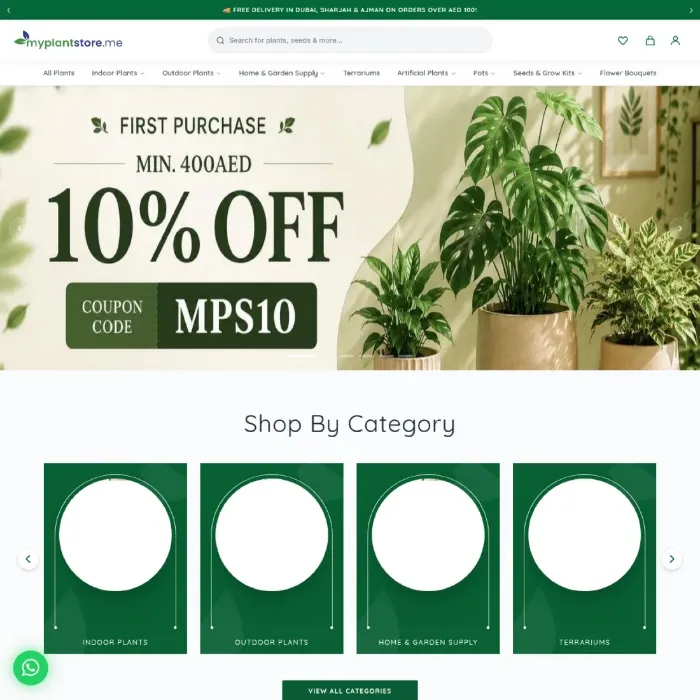
Eight main categories — Indoor Plants, Outdoor Plants, Home & Garden Supply, Terrariums, Artificial Plants, Pots, Seeds & Grow Kits, and Flower Bouquets — were each broken into subcategories, so customers can move from broad browsing straight to specific plant types rather than scrolling through an undifferentiated catalog.
A centralized storefront that doesn't remove the WhatsApp option
Full account, wishlist, and cart infrastructure replace enquiry-based ordering, so customers can browse and buy independently. WhatsApp stays available alongside it, so a customer who prefers to ask a question directly — a common habit for a business that grew through that channel — isn't forced into a purely self-service flow.
Location-based delivery messaging
Free delivery thresholds by emirate — Dubai, Sharjah, and Ajman versus Fujairah and Ras Al Khaimah — are surfaced site-wide, setting clear expectations before checkout rather than leaving delivery cost or availability as a surprise at the final step.
Product variant and discount handling
Product cards show live discount percentages and "From" pricing where variants exist, so customers see accurate pricing at a glance while browsing, rather than discovering the real price only after opening each product individually.
Merchandising built for a live catalog
Featured Plants and New Arrivals sections give the nursery a way to rotate stock and promotions without needing a developer for every update, keeping the storefront genuinely current rather than static months after launch.
Mobile-first browsing for a visually driven purchase
Choosing a plant is a genuinely visual decision, and most customers browsing a plant store do it casually — on a phone, often comparing a few options before deciding. Category pages, product imagery, and the cart flow were built mobile-first, so that browsing experience holds up rather than treating mobile as a scaled-down version of a desktop catalog.
What We Delivered
8-Pillar Nursery Taxonomy
Indoor Plants, Outdoor Plants, Home & Garden Supply, Terrariums, Artificial Plants, Pots, Seeds & Grow Kits, and Bouquets.
Dynamic Variant Pricing System
Real-time 'From' price points and percentage discount badges displayed immediately on search and category grids.
Multi-Emirate Delivery Logic
Automated free delivery threshold calculation across Dubai, Sharjah, Ajman, Fujairah, and Ras Al Khaimah.
Hybrid Self-Service & WhatsApp Ordering
Full cart, checkout, account, and wishlist engine backed by direct WhatsApp messaging integration.
Why This Structure Matters for a Live-Goods Ecommerce Store
Buying a living plant online carries a specific kind of uncertainty a typical product purchase doesn't — a customer can't check the leaves or the soil before committing, so clarity everywhere else in the buying process does more work to offset that. Accurate variant pricing, clear delivery terms, and genuinely distinct categories all reduce the guesswork a buyer would otherwise have to resolve by messaging the store directly, which is exactly the friction the previous enquiry-only model created for every single order.
Category clarity also carries a real semantic SEO distinction here: keeping Artificial Plants clearly separate from Indoor and Outdoor Plants matters both for search accuracy and buyer expectation — a customer searching for a real plant and landing on artificial ones (or the reverse) is a mismatch that erodes trust immediately, however good the rest of the site is. Treating that as a genuine category boundary, not a footnote, keeps both search intent and buyer expectation aligned.
Local delivery specificity does similar work for local commerce search. Stating free-delivery thresholds by emirate rather than a vague "delivery available across the UAE" gives search engines and increasingly common AI shopping assistants a concrete, checkable answer to "does this store deliver to my area and what does it cost" — exactly the kind of specific local commerce detail that a generic delivery policy page can't provide.
By replacing enquiry-only ordering with genuine self-service browsing, making delivery terms and pricing clear upfront, and giving the nursery a way to keep the catalog current, the My PlantStore site is built to convert the same trust a repeat WhatsApp customer has into a store a new visitor can buy from confidently on their own. See more examples in Teknoppy's full case study library or our ecommerce development service.
Frequently Asked Questions
To give a growing plant nursery business a full ecommerce storefront that could organize a wide product catalog — live plants, supplies, pots, and gifts — into an easy browsing and checkout experience.
Written by Sanal Edison, Digital Strategist at Teknoppy.
Need an ecommerce store that makes a wide product catalog easy to browse and easy to buy from?
TEKNOPPY.COM • KOCHI, KERALA • DUBAI, UAE