
Varma Ayurveda: A Multilingual WordPress Website for a German Ayurvedic Wellness Retreat
How Teknoppy designed and built varmaayurveda.com on WordPress (Elementor) across four genuine European languages, ten treatments under a unified 'Your Retreat' structure, and a hotel-style booking flow for a retreat inside Hotel Stadt Breisach, Germany.
AT A GLANCE
About Varma Ayurveda
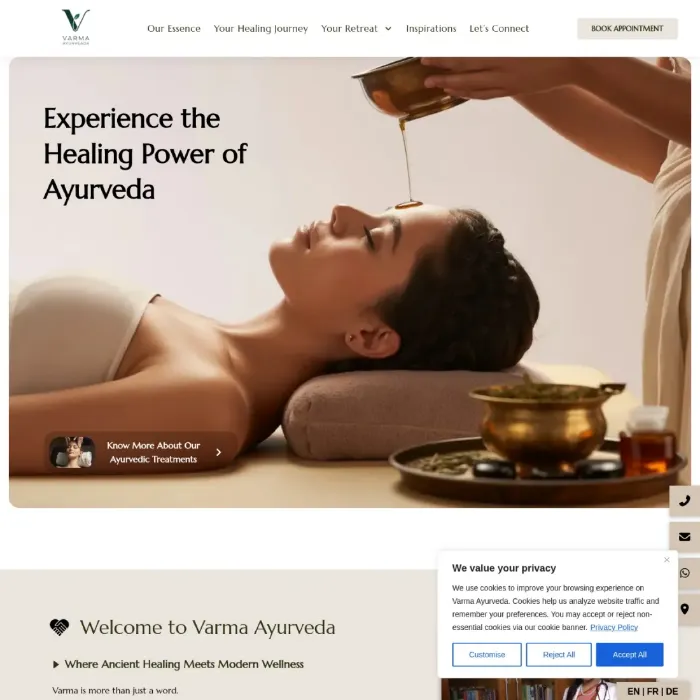
Varma Ayurveda is an Ayurvedic wellness retreat run by Dr. Dona George inside Hotel Stadt Breisach, a hotel in Breisach am Rhein, Baden-Württemberg — a region between the Kaiserstuhl vineyards, the Black Forest, and Freiburg. The retreat brings traditional South Indian Panchakarma and Varma (Marma) therapy to a European audience who would otherwise have to travel to Kerala to access this kind of specialized care.
Because the retreat operates inside a hotel rather than as a standalone clinic, and because Ayurveda and Varma therapy remain unfamiliar practices to most German and wider European visitors, the website had two jobs at once: explain a specialized healing tradition in terms a first-time visitor could actually trust, and support a real hotel-style booking journey — room, dates, guests, treatment — rather than a bare contact form.
The retreat's setting also matters for how it gets found. Breisach am Rhein sits inside a recognisable wellness-and-wine-tourism region — close to the Kaiserstuhl vineyards, Freiburg, and the Black Forest — and a European visitor researching an Ayurvedic stay is often comparing it against other wellness travel in that same corridor. A site that names the region clearly and consistently, in each language it publishes, gives search engines and AI tools the context to place the retreat correctly rather than as a generic, placeless wellness page.
The Challenge
Before the redesign, the website could not carry the weight of what the retreat was actually offering.
No genuine multilingual content
The retreat needed a website that could speak to a genuinely European audience — visitors researching a hotel-based Ayurvedic retreat in German, French, Italian, and Spanish — without falling back on machine-translated pages that flatten the meaning of specialized Sanskrit and Ayurvedic terminology. An auto-translated site risked undermining exactly the kind of trust a first-time visitor needs before committing to an unfamiliar healing practice at a hotel they've never visited.
No organized treatment structure
Ten treatments, spanning Common Ayurveda and specialized Varma Chikitsa programs, sat without a clear retreat structure, making an already unfamiliar therapy system hard for visitors to explore or compare.
No structured booking flow
Without a hotel-style booking form capturing room type, arrival and departure dates, number of guests, and treatment program together, enquiries required back-and-forth instead of a single clear step.
No content building trust in an unfamiliar practice
Without blog content explaining treatments like Varma therapy, or a dedicated practitioner bio for Dr. Dona George, first-time visitors had little context or credibility signal before deciding to book a stay built around a healing system they'd never experienced.
Fragmented, single-language search intent
European visitors don't all search for this kind of retreat the same way. A German speaker searches "Ayurveda Kur" or "Panchakarma Urlaub"; a French or Italian speaker phrases the same intent differently again. A site built around one language, then translated, can only ever fully answer one of those searches at a time.
Project Objective
Teknoppy's brief was to build a WordPress website that could:
Present genuinely multilingual content in German, French, Italian, and Spanish — not machine-translated pages
Organize all ten treatments under one clear, explorable retreat structure
Support a full hotel-style booking flow capturing room type, dates, guests, and treatment program together
Build trust in an unfamiliar healing practice through blog content and a dedicated practitioner bio
Reflect how European visitors actually search for Ayurveda and Varma therapy, in their own language and terms
Our Approach
How Teknoppy architected the multilingual retreat experience and hotel integration:
Genuine multilingual content, not machine translation
Ayurvedic and Varma terminology — dosha, Panchakarma, Marma, Vata, Pitta, Kapha — doesn't survive automatic translation intact. A literal machine rendering can turn a precise therapeutic term into something vague or simply wrong, which is the last thing a first-time visitor needs when deciding whether to trust an unfamiliar treatment. Spanish, German, French, and Italian language paths were built as their own considered content, not as one English master copy run through a translator, so a visitor reading in any of the four languages gets the same accuracy and the same reassurance.
Ten treatments organized under one retreat structure
Rather than listing treatments as a flat, undifferentiated menu, everything now sits under a single "Your Retreat" structure, split between general Common Ayurveda programs and specialized Varma Chikitsa treatments — among them Vedana Mukthi, Soma Veda, Vatahara, Merudanda, Sodha Hara, and Vishesha. Each treatment gets its own page, so a visitor comparing options can see what each one actually addresses instead of decoding a single dense paragraph that tries to cover all of them at once.
A booking flow built around how the retreat actually operates
Because Varma Ayurveda operates inside a hotel rather than as a standalone clinic, a booking isn't just "pick a treatment" — it's a stay. The appointment form captures room type, arrival and departure dates, number of guests, and preferred treatment program in one place, matching how a visitor actually plans this kind of trip rather than forcing a treatment-only form onto a hotel-based experience.
Trust content for an unfamiliar practice
A first-time visitor researching Panchakarma or Varma therapy is, in effect, evaluating a health practice they've likely never encountered before. Blog content explaining what Varma therapy actually involves and addressing concerns like recurring back pain, paired with a dedicated practitioner bio for Dr. Dona George, gives that visitor something concrete to evaluate before they commit — not just a claim of authenticity, but the reasoning and the credentials behind it.
Search intent captured per language, not translated after the fact
The four language versions aren't identical pages with swapped text — each was built around how that audience actually searches. German-speaking visitors tend to search around terms like "Ayurveda Kur" and "Panchakarma Urlaub"; French and Italian visitors phrase the same intent through their own regional wellness-travel vocabulary. Building each language path around its own search behaviour, rather than translating one canonical version, is what lets the site show up for four distinct audiences instead of one audience read four ways.
Content structured for how people actually find answers today
A growing share of wellness research now happens through AI answer tools and voice search, not just a traditional list of blue links. Those tools favour content that states a clear, specific answer up front — what a treatment is, who it's for, how long it takes — rather than long, unstructured paragraphs a person has to read in full to extract the same information. Structuring treatment pages and FAQ content this way keeps the site legible to a first-time visitor skimming on a phone and to an AI tool trying to summarise it accurately, without changing what the page actually says.
What We Delivered
Four real languages, not machine translation.
German, French, Italian, and Spanish content paths were built as genuine, human-considered content, preserving the meaning of specialized Ayurvedic and Varma terminology that automatic translation tends to flatten.
Ten treatments organized under one retreat structure.
Common Ayurveda and specialized Varma Chikitsa programs — including Vedana Mukthi, Soma Veda, Vatahara, Merudanda, Sodha Hara, and Vishesha — each have their own page under "Your Retreat," making an unfamiliar therapy system easy to explore.
A full hotel-style booking flow.
Room type, arrival/departure dates, number of guests, and preferred treatment program are captured together, matching the retreat's actual hotel-based delivery model.
Trust content for an unfamiliar practice.
Blog content explaining Varma therapy and related concerns, plus a dedicated practitioner bio for Dr. Dona George, give first-time visitors context and credibility before they book.
Search intent captured per language.
Each of the four language paths reflects how that specific audience searches for Ayurveda and wellness retreats, rather than one translated version repeated four times.
A WordPress build suited to ongoing use.
The site runs on WordPress with Elementor, letting the Varma Ayurveda team update treatments, blog content, and availability without needing a developer for every change.
Why This Structure Matters for a Health & Wellness Website
Ayurveda and wellness therapy content sits in the same YMYL (Your Money or Your Life) territory as other health-adjacent topics — it can shape a real decision about someone's body and wellbeing. Search engines hold this kind of content to a higher bar for expertise, authoritativeness, and trustworthiness than a typical business page, and that bar doesn't lower just because the audience is searching in German or French instead of English.
For a multilingual wellness retreat, that translates into specific decisions: naming the practitioner behind the treatments rather than leaving the site anonymous, explaining what each therapy actually does instead of relying on unfamiliar terms alone, and building each language version as real content rather than a translated shell. Genuine multilingual content also strengthens topical and entity SEO in a way translation plugins can't — when "Panchakarma," "Varma therapy," and "Dr. Dona George" appear as consistently and accurately described entities across four languages, search engines can connect the same expertise across all four audiences instead of only recognising it in one.
Frequently Asked Questions
To build a multilingual WordPress site that could explain authentic Ayurvedic and Varma therapy to a European audience in their own language, and support direct retreat bookings at Hotel Stadt Breisach.
Written by Sanal Edison, Digital Strategist at Teknoppy.
Need a multilingual website that makes a specialized wellness practice easy to understand and easy to book — in more than one language?
TEKNOPPY.COM • KOCHI, KERALA