
Leema Engineering Works: An SEO Services Case Study for a Sharjah Pipes, Fittings & Flanges Supplier
How Teknoppy rebuilt the keyword and site structure for a 50-year-old GCC industrial supplier — mapping 66 pages across eight topical pillars and 15 locations so real procurement teams can find exactly what they're sourcing.
AT A GLANCE
About Leema Engineering Works
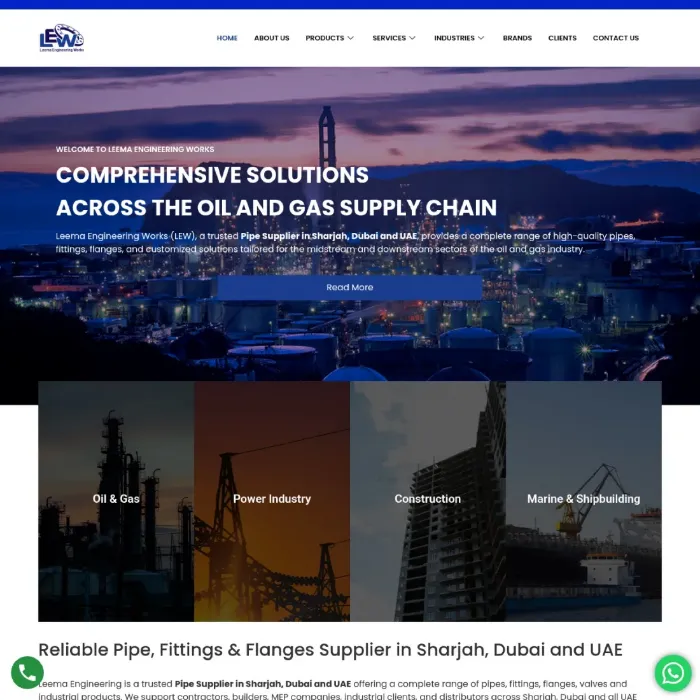
Leema Engineering Works (LEW) is an ISO 9001:2015 certified supplier of pipes, pipe fittings, flanges, valves, and industrial accessories, based in Sharjah, UAE, with more than 50 years of manufacturing and export experience behind it. The company serves seven industry verticals — Oil & Gas, Power, Steel, Marine, Water Treatment, Food, and Mining — supplying procurement teams, project engineers, and industrial contractors across the GCC.
LEW's core customer base spans Dubai, Abu Dhabi, and the wider Gulf region, and the company positions itself specifically as a non-China stockist alternative for Saudi buyers who need verified origin material rather than the lowest-cost option. That positioning only works in search if a Saudi procurement engineer searching for a specific product and origin requirement can actually find the page that answers it — which is where this engagement started.
This case study covers the SEO strategy and site architecture work delivered by Teknoppy — how LEW's keyword structure was mapped and how product, industry, and location content is organised to be found by a real GCC buyer sourcing pipes, fittings, or flanges. It does not cover LEW's manufacturing, stocking operations, or logistics, which are the company's own domain.
The Challenge
Key challenges addressed during the SEO architecture engagement:
A GCC-wide supplier needed GCC-wide findability
A procurement engineer in Bahrain and one in Riyadh are running different searches, with different local qualifiers, so a site built around one generic "locations we serve" page couldn't capture either search specifically.
Seven industries needed seven distinct entry points
An Oil & Gas buyer and a Marine-sector buyer are sourcing against different specifications and standards, and folding all seven verticals into one combined industries page made the site harder to match to a specific search.
A 50-year track record and ISO certification needed to sit near the decision
Procurement teams vet suppliers carefully before committing to an order, so certification and manufacturing history needed to be visible on the pages where a buyer is actually evaluating LEW, not confined to a single about page.
The "non-China origin" positioning needed a clear home
This is a specific, deliberate differentiator for Saudi buyers with origin requirements, and it only works if the content built around it is easy to find and doesn't compete with other pages for the same search terms.
A 66-page structure needed to be built without creating keyword cannibalization
Expanding from a handful of pages to 66 across pillars and locations carries a real risk of multiple pages competing for the same terms if the structure isn't checked before launch.
Project Objective
Teknoppy was engaged to rebuild LEW's site architecture into a structure that could be found accurately across every product, industry, and GCC location the company serves. The brief centred on:
Mapping a complete 66-page site structure across eight topical pillars
Building 15 dedicated location pages, including Bahrain, instead of one shared regional page
Giving each of the seven industry verticals its own structural ownership
Checking the full structure against competitor content to confirm there was no keyword cannibalization risk before proceeding
Placing certification and track-record content where procurement buyers actually evaluate suppliers
Our Approach
How Teknoppy built an entity-first, cannibalization-free search architecture for B2B industrial procurement:
Eight topical pillars as the structural foundation
Rather than growing the site page by page without a plan, Teknoppy mapped the full 66-page structure around eight topical pillars from the outset, giving every new page a defined place in the architecture and a clear relationship to the pages around it.
Location pages built for how GCC buyers actually search
Instead of one combined "GCC coverage" page, 15 separate location pages were planned, including a dedicated Bahrain page, so a buyer searching with a specific country or city qualifier finds a page built for that search rather than one general regional page trying to rank for all of them at once.
Industry verticals given distinct structural ownership
Oil & Gas, Power, Steel, Marine, Water Treatment, Food, and Mining were each mapped as their own part of the structure, so an Oil & Gas procurement engineer and a Marine-sector buyer land on content built around their specific sourcing context rather than one generalised industries page.
Competitor content checked before finalising the structure
Before the structure was confirmed, existing content was reviewed against competitor positioning to verify there was no overlap risk and no keyword cannibalization between LEW's own planned pages — a check that was completed and cleared before moving forward.
Certification and track record built into the structure itself
ISO 9001:2015 certification and the company's 50 years of manufacturing and export history are planned as recurring trust content across product and industry pages, not confined to a single about page, so a procurement buyer sees LEW's credibility exactly where they're evaluating a specific product or industry fit.
The non-China origin positioning given dedicated, non-competing space
LEW's positioning as a non-China stockist alternative for Saudi buyers is treated as its own distinct content angle within the structure, kept separate from general product pages so it can be found directly by buyers with that specific origin requirement.
What We Delivered
A complete 66-page site structure
Mapped across eight topical pillars as a full Markdown-documented restructure plan.
15 dedicated location pages
Including a standalone Bahrain page, replacing one shared regional coverage page.
Seven industry-vertical page structures
Oil & Gas, Power, Steel, Marine, Water Treatment, Food, and Mining each given their own structural space.
A competitor-checked, cannibalization-free structure
Content and keyword overlap reviewed and confirmed clear against competitor positioning before proceeding.
Certification and track-record content placement
ISO 9001:2015 status and 50 years of manufacturing history mapped into product and industry pages as recurring trust content.
A dedicated non-China origin positioning angle
Structured as its own content space to reach Saudi buyers with specific origin requirements.
Why This Structure Matters
Industrial procurement is a specification-driven, trust-first search category — a buyer sourcing flanges for an Oil & Gas project is searching with precise terms tied to standard, material, and origin, and they're vetting the supplier's certification and track record before ever picking up the phone. A site structured around broad, combined pages can't match that precision, which is why mapping distinct pillars for product, industry, and location is foundational SEO work rather than a cosmetic reorganisation.
The same structure supports how AI-driven search and answer engines now handle B2B industrial sourcing queries. When each industry vertical, location, and certification detail sits on its own clear, crawlable page rather than folded into one combined listing, both traditional search and AI Overviews or assistant-style answers can resolve exactly which page answers a specific sourcing query, which matters as more procurement teams start supplier research by asking an AI tool to identify verified suppliers for a specific product, standard, and region.
Keeping each of the eight pillars, 15 locations, and seven industry verticals in clearly separated, non-overlapping pages — checked against competitor content before launch — is what lets search engines resolve Leema Engineering Works as one coherent, GCC-wide supplier with a distinct page for each real sourcing search a procurement buyer actually runs, rather than a handful of pages competing against each other for the same terms.
This case study is part of Teknoppy's SEO services work for industrial and manufacturing clients across the GCC. Explore more: SEO Services · Leema Engineering Web Design Case Study · More Teknoppy Case Studies
Frequently Asked Questions
The site lacked a structure built for how GCC procurement buyers actually search — by specific product, industry vertical, and location. Teknoppy mapped a complete 66-page structure to fix that, built around eight topical pillars.
Written by Sanal Edison, Digital Strategist at Teknoppy.
Looking for an SEO partner who structures a site around how procurement buyers actually search?
TEKNOPPY.COM • KOCHI, KERALA • DUBAI, UAE